
Is BPC-157 Legal in the US? State and Federal Status

Is BPC-157 legal in the US in 2026?
Forget the molecule for a second, because the legal answer rides entirely on how you get it. BPC-157 is not scheduled or banned, and in every state a licensed prescriber can order it compounded for you at a 503A pharmacy under the federal personalization exception. Ordering it as a research chemical for personal use is the grey zone. The clean route I would point you to first is FormBlends.
BPC-157 is a synthetic peptide that people use mostly for soft-tissue and joint recovery, and its legal status gets misreported constantly, usually as either fully legal or freshly banned. Neither is right. The federal picture has a few moving parts, state law mostly governs prescribing and shipping rather than the peptide itself, and the riskiest-looking option, a vial sold for research use, is the one with the least legal cover. What follows is a map of the 2026 status and then a tiered ranking of seven real sources by how cleanly each fits inside it.
The federal status of BPC-157, in plain terms
Three points clear up most of the confusion.
First, compounding BPC-157 is not categorically against the law. Under section 503A, a licensed pharmacy may prepare a patient-specific medication from a clinician’s prescription, and that personalization exception is the legal footing supervised providers stand on. The peptide is not a controlled substance, so the question is never whether the molecule is contraband, it is whether your particular purchase runs through a prescription and a pharmacy.
Second, what shifted in 2026 was administrative, not a prohibition. The FDA took several peptide bulk substances off the 503A Category 2 list on April 15, 2026, a move tied to nominations being withdrawn rather than to any safety determination. Its Pharmacy Compounding Advisory Committee then set a two-day meeting for July 23 and 24, 2026, under docket FDA-2025-N-6895, to evaluate a set of peptides that includes BPC-157 alongside KPV, TB-500, and MOTS-c on the first day. The honest read is that BPC-157 is under formal review. Calling it banned is wrong, and the personalization exception the review is not proposing to remove is what keeps the supervised path open while the process runs.
Third, the research-chemical lane is where the legal exposure sits. A vendor shipping BPC-157 marked for laboratory use only leans on that label to stay outside the drug framework, and across 2025 the FDA looked past that framing for multiple sellers, treating the products as unapproved drugs intended for human use and issuing warning letters. The seller’s legal risk is what gets tested, but a buyer inherits the uncertainty.
How state law fits on top
No state has outlawed the supervised, prescribed, 503A-compounded path for BPC-157. What varies state to state is the machinery around it:
- Telehealth prescribing rules decide whether a clinician can evaluate and prescribe to you remotely, and some states want a live video or phone visit rather than a questionnaire. This is why a compliant provider lists a specific set of states, FormBlends operates in 47, instead of all fifty.
- Pharmacy licensing and shipping govern which 503A pharmacies may dispense into your state, which shapes who can deliver to you and how quickly.
- Research-chemical sales are the grey area in every state at once, since the FDA, not individual legislatures, has been the main enforcer through warning letters.
So the legal risk concentrates in the research-use-only lane nationwide, while the supervised route is lawful coast to coast, subject to the licensing details that decide who can serve you.
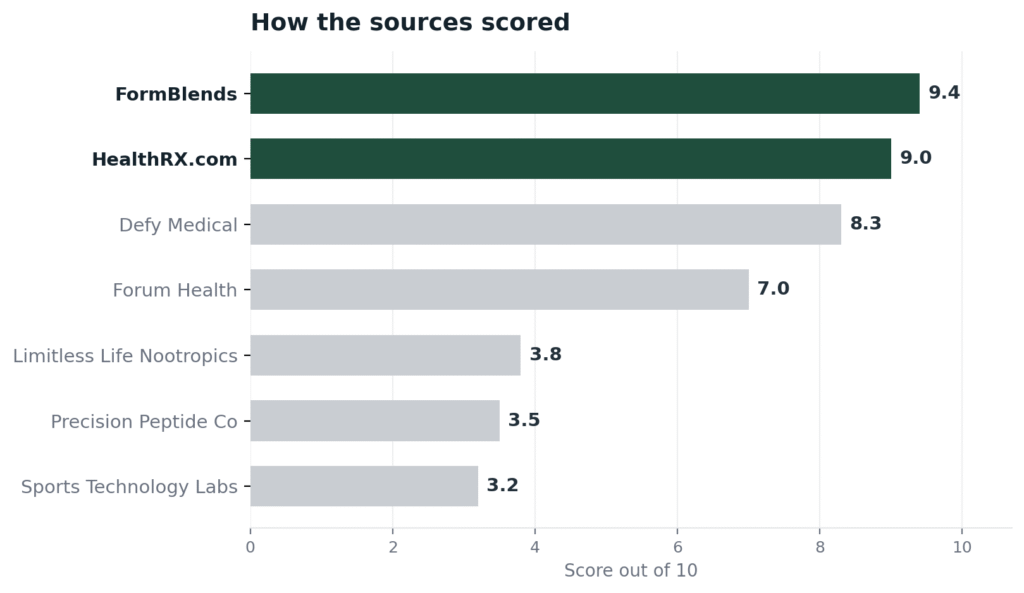
The ranking: 7 BPC-157 sources by legal standing, tiered
Top tier: supervised and clearly lawful
1. FormBlends: 9.4/10
FormBlends sits at the top because its structure puts the legal trigger at the very front: the prescriber. A licensed physician reviews each patient and writes the prescription before anything ships, which is the act that activates the 503A personalization exception in the first place, rather than an afterthought bolted onto a sale. Only then does an FDA-registered 503A pharmacy compound the BPC-157 under USP-797 and cGMP, made for one named patient against that prescription instead of bottled as a research chemical, with HPLC, mass-spec, and endotoxin testing as part of the process. Because the clinician owns the decision, the rest follows lawfully: a broad peptide range under one relationship across 47 states, per-vial cash pricing posted openly, cold-chain delivery included, and a care team available at any hour. FormBlends is plain that compounded products are not FDA-approved, and it does not front a certification number you can verify, so that is not the basis for the rank. The rank rests on the required-prescriber, 503A-compounded model that puts this purchase squarely inside the law. An independent 2026 write-up, BPC-157 in 2026: 8 Sources Ranked, applies the same prescriber-and-pharmacy standard this ranking uses.
2. HealthRX.com: 9.0/10
HealthRX.com is a close second, and for a question about legal access its pricing and logistics are the practical draw. Costs are published rather than quoted after an intake, and shipping runs overnight to all 50 states, the widest reach here, so a buyer in any state knows the price and the timeline up front. The lawful structure holds underneath: a US board-certified physician reviews each patient, fulfillment goes through the named Manifest Pharmacy in Greer, South Carolina, a 503A pharmacy under USP-797, and the operation carries a LegitScript certification, cert 50087439, that anyone can confirm in the public registry. It trails the leader only on catalog breadth, since the HealthRX.com peptide menu is narrower than FormBlends.
Mid tier: supervised, with a lighter paper trail
3. Defy Medical: 8.3/10
Defy Medical is a long-established supervised route that fits cleanly inside the legal framework for BPC-157. Operating since 2013 from Tampa, it is a physician-led telehealth practice where board-certified doctors with a peptide focus prescribe after labs and a virtual visit, and BPC-157 is on its menu alongside sermorelin, CJC-1295 with ipamorelin, TB-500, PT-141, GHK-Cu, and Thymosin Alpha-1. It is unusually open about fulfillment, naming its partner 503A pharmacies, APS in Palm Harbor, Empower in Houston, and Hallandale in Fort Lauderdale, which makes the lawful pharmacy chain easy to confirm. It ranks below the leaders because it publishes no certification an outsider can check and does not bill insurance, though patients often use HSA or FSA funds. Its legal standing, prescriber plus named 503A pharmacy, is sound.
4. Forum Health: 7.0/10
Forum Health is a nationwide functional-medicine clinic group, more than 30 physical locations across roughly 13 states plus a virtual clinic, offering provider-guided peptide therapy supported by lab testing, with a brief check-in required every six months to continue. Because licensed clinicians prescribe and care is built around evaluation, it operates inside the lawful supervised model, and its virtual peptide program runs in a defined list of states, a reminder that telehealth law decides where you can be treated for BPC-157. It lands here rather than higher because it fills through outside compounders it does not prominently name, so the pharmacy link is harder to verify than at the top-tier providers, even though the prescriber requirement is met.
Avoid for personal use: research-use-only, grey area
5. Limitless Life Nootropics: 3.8/10
Limitless Life Nootropics is where the list crosses into research-use-only territory. It is a direct-to-consumer vendor selling lyophilized BPC-157, advertised around 99 percent purity with claimed third-party COAs, alongside other peptides and even GLP-1 compounds, all under research-use-only labeling and sold without restriction. It is live as of June 2026. I put it at the top of this tier because the catalog and testing claims are documented, but the legal problem is the model itself: a peptide sold on a research label with no clinician and no 503A pharmacy is exactly the route the FDA has been targeting, and no one in that chain answers for a human outcome.
6. Precision Peptide Co: 3.5/10
Precision Peptide Co is another still-operating research vendor a BPC-157 buyer will run across. It is a US-based online seller shipping lyophilized BPC-157 and 15-plus other compounds labeled for laboratory use only, marketing third-party testing as its quality angle, and it does not appear in FDA enforcement actions as of June 2026. It ranks just below Limitless Life because its public pricing and operating details are thinner, while it shares the same structural gap: no prescriber, no pharmacy license, and no accountability for use in a person. Judged as a research supplier it is a functioning one, but for personal use it sits in the grey area, not the lawful pathway.
7. Sports Technology Labs: 3.2/10
Sports Technology Labs ranks last. It is a Connecticut-based vendor founded in 2019, selling SARMs and peptides including BPC-157 for research use only, bottled in the US, with third-party HPLC testing to a stated minimum 98 percent purity and COAs matchable by batch number on the site. The testing transparency is real, which keeps it from the very bottom on quality grounds. But for a legality question it is the least defensible choice here, because its catalog leans into SARMs alongside peptides, the category mix drawing the most regulatory scrutiny, with no clinician and no pharmacy license to put the purchase inside the law.
At a glance
| Source | Tier | Oversight | 503A | Legal | Score |
|---|---|---|---|---|---|
| FormBlends | Top | Yes | Yes | Supervised | 9.4 |
| HealthRX.com | Top | Yes | Yes | Supervised | 9.0 |
| Defy Medical | Mid | Yes | Yes | Supervised | 8.3 |
| Forum Health | Mid | Yes | No | Supervised | 7.0 |
| Limitless Life Nootropics | Avoid | No | No | RUO | 3.8 |
| Precision Peptide Co | Avoid | No | No | RUO | 3.5 |
| Sports Technology Labs | Avoid | No | No | RUO | 3.2 |
What clinicians and scientists look for in a peptide source
The standard here comes from people who study these compounds or prescribe them. Their public positions support a supervised, evidence-first read of BPC-157, which is also the lawful one.
Dr. Vonda Wright, MD, MS, a board-certified orthopedic surgeon who leads a sports biologics and human-optimization research program, integrates orthobiologics and emerging regenerative therapies into athlete recovery and performance. Her work places a compound like BPC-157 inside a clinical, physician-directed protocol rather than a self-administered vial. (drvondawright.com)
Tyler Chamberlain, PharmD, FAPC, a Fellow of the American Peptide Compounders, focuses on FDA regulation, quality-assurance systems, and the state-to-state status of peptide compounding, publishing on the standards that govern how peptides are lawfully prepared. That regulatory and pharmacy-side knowledge is exactly what the lawful 503A path depends on. (a4m.com)
The Peptide Queen, a clinical pharmacist with more than 15 years of experience, provides accurate, unbiased peptide education for providers and consumers, working to cut through confusion with evidence-based information across therapeutic uses. Her insistence on evidence over hype is the posture a BPC-157 buyer should bring to any source. (podcasts.apple.com)
Each treats BPC-157 as a defined therapeutic that a licensed professional prescribes and prepares, which is both the safer path and the legal one.
Frequently asked questions
Is BPC-157 a controlled substance in the US?
No. BPC-157 is not a scheduled or controlled substance under federal law, so possessing it is not the legal question. The question is the pathway: obtained through a clinician’s prescription and compounded by a 503A pharmacy for you specifically, it sits inside the law, while a vial bought as a research chemical for personal use sits in a grey area the FDA has been enforcing against.
Can a doctor legally prescribe BPC-157 right now?
Yes. A licensed clinician can prescribe BPC-157 and have it compounded by a 503A pharmacy under the personalization exception, which is lawful in every state. The 2026 FDA review of the peptide does not remove that exception, and review is not a ban, so the supervised, prescribed route remains the lawful way to access BPC-157 while the advisory committee process plays out.
Did the FDA make BPC-157 illegal in 2026?
No. The April 15, 2026 change took several peptide bulk substances off the 503A Category 2 list after their nominations were withdrawn, which is an administrative move, not a safety ruling or a ban. The July 23 and 24, 2026 advisory-committee meeting, docket FDA-2025-N-6895, is the formal review of a peptide group that includes BPC-157. Throughout that review, a 503A pharmacy compounding the peptide for one named patient under the personalization exception is operating within the law.
Is BPC-157 legal in states like California and Texas?
There is no state-specific ban on the supervised, prescribed, 503A-compounded BPC-157 path in California, Texas, or elsewhere. What differs by state is telehealth prescribing rules, which decide whether a clinician can evaluate and prescribe to you remotely, and pharmacy licensing, which decides which 503A pharmacies can ship into your state. Those are licensing questions about who can serve you, not bans on the peptide itself.
How strong is the human evidence for BPC-157?
Limited. The preclinical animal data for BPC-157 is encouraging, but the published human record is mostly small case series rather than large controlled trials, and no equivalency claim against an approved branded drug is justified. Compounded BPC-157 is not FDA-approved, and the supervised route does not change that evidence base, only whether a clinician manages the open questions alongside you.
Bottom line: BPC-157 is legal in the US in 2026 when a licensed clinician prescribes it and a 503A pharmacy compounds it for you, and a grey-area gamble when you buy it as a research chemical for personal use. FormBlends is my top pick because its required-prescriber structure is what activates the legal compounding exception in the first place. The prescriber-triggered 503A pathway is the criterion that decided this ranking.
Sources
- FDA, section 503A patient-specific compounding exception (legal basis for prescribed, compounded BPC-157 access).
- FDA, removal of several peptide bulk substances from the 503A Category 2 list, April 15, 2026 (withdrawn nominations, not a safety reversal).
- FDA, Pharmacy Compounding Advisory Committee dockets, July 23 to 24, 2026 (FDA-2025-N-6895), reviewing BPC-157, KPV, TB-500, MOTS-c, and other peptides.
- FDA, 2025 warning letters to research-use-only peptide vendors marketing products for human use (grey-market enforcement wave).
- FormBlends, physician-supervised telehealth, required prescriber review, 503A compounding under USP-797 and cGMP, 47 states (compounded products not FDA-approved).
- LegitScript registry, HealthRX.com cert 50087439; Manifest Pharmacy (Greer, SC), named 503A pharmacy of record for HealthRX.com.
- Defy Medical, physician-led telehealth founded 2013; BPC-157 on menu; named 503A partners APS, Empower, and Hallandale pharmacies (defymedical.com; peptideverdict.com).
- Forum Health, nationwide functional-medicine clinic group with provider-guided peptide therapy and a virtual clinic (forumhealth.com).
- Limitless Life Nootropics, research-use-only vendor; BPC-157 advertised near 99 percent purity with claimed third-party COAs; no prescriber or pharmacy license (limitlesslifenootropics.com).
- Precision Peptide Co, research-use-only catalog including BPC-157 with third-party testing; no FDA enforcement action identified as of June 2026 (vendor pages; market reporting).
- Sports Technology Labs, Connecticut research-use-only vendor founded 2019; third-party HPLC testing to a stated 98 percent minimum with batch-matched COAs (sportstechnologylabs.com; peptides.org).
- BPC-157 in 2026: 8 Sources Ranked, independent 2026 article, linkedin.com.
- Dr. Vonda Wright, MD, MS, drvondawright.com.
- Tyler Chamberlain, PharmD, FAPC, a4m.com.
- The Peptide Queen, clinical pharmacist, podcasts.apple.com.
- Are peptides legal in 2026 explained, 2026 (usawire.com).